





72% of employers can’t fill the roles they need, and AI talent tops that shortage list. While most companies are only now feeling the squeeze, we saw it coming in 2019.
Back then, our founding team was building advanced AI projects that left little room for guesswork. Each one came with the same underlying pressure. Success depended on finding people who understood AI-related work deeply and could bring real judgment to it.
The more AI projects we took on, the clearer that became. Tools could be learned, and workflows could be taught, but the depth of AI knowledge these projects demanded was much harder to find.
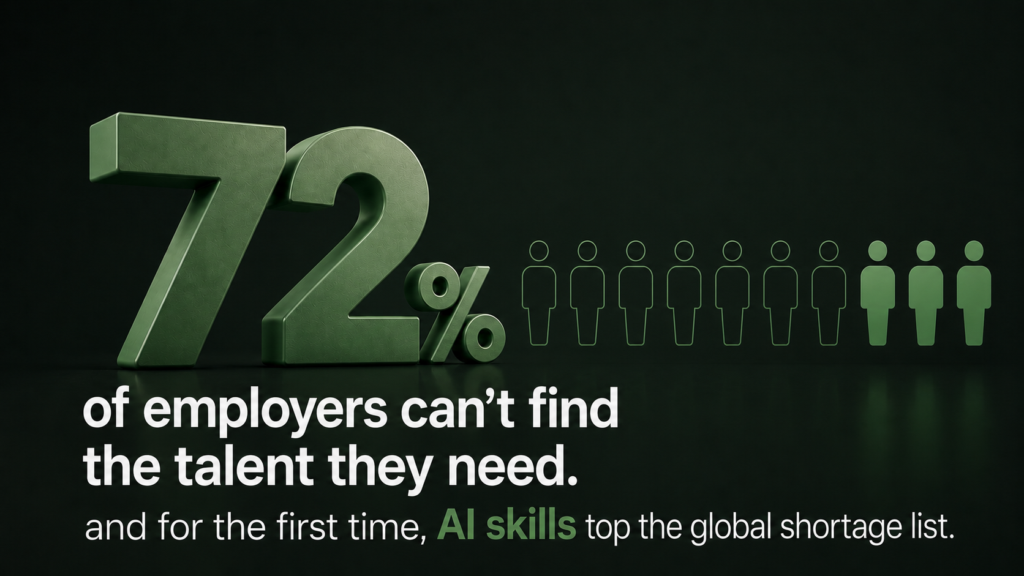
AI Skills Now Top the Global Talent Shortage for the First Time
Like most teams, we wrote detailed job descriptions and opened applications to global talent pools. There was no shortage of interest. Resumes were polished, portfolios were impressive, and candidates often looked like a strong fit on paper.
But the real test came once the work started. A resume told us what someone had done before, but not how they actually thought. We couldn’t tell how they would handle a hard problem, or whether they were truly right for the project, until the work was already underway.
Meanwhile, AI kept advancing, with new models and applications emerging every year. Yet the way companies found and evaluated specialized AI talent had barely changed.
We didn’t need more candidates. We needed a better way to identify the right AI talent before the work began. That problem is what led us to build Liceum.ai.
Why Finding AI Talent Was Our Hardest Problem in 2019
In 2019, our founding team was deep in AI projects. The more work they took on, the more they kept running into the same challenge. Success depended on people making the right decisions long before an AI model could ever be trained.
Most of that work came down to data. Labeling it, evaluating it, and deciding what was good enough to train on. And the people doing it needed real domain expertise, because the hardest calls weren’t technical at all.
Consider a legal AI project. A single clause can shift the meaning of an entire contract, and only someone who understands contract law can tell whether an annotation captured that shift or quietly lost it. The decision looks small on the screen, but it defines what the model comes to understand as correct.
The same is true for language work that depends on nuance. When we needed to evaluate whether a model’s answer was subtly wrong rather than obviously wrong, only someone with real subject knowledge could catch the difference. A response could read fluently and still be confidently incorrect, and spotting that took judgment no checklist could replace.
None of that judgment showed up on a resume, yet all of it shaped what an AI model learned. That made AI work very different from a typical freelance project. Every annotation, evaluation, and edge-case decision became part of the training signal. The work didn’t end with a finished file. It carried forward into how the AI system performed in production.
A single missed detail rarely stayed contained. It surfaced later, baked into the model. Research suggests this is part of why more than 80% of AI projects fail to reach production, with success depending far more on people and judgment than on the technology itself.
For projects that depended on human judgment at every stage, the AI talent gap wasn’t a minor inconvenience. It was the thing holding everything else back.
Traditional Marketplaces Fail at Finding AI Talent
When we set out to find a tool that could help us find AI and ML talent, we followed the usual path. We turned to familiar freelance platforms, posted detailed job requirements, and waited for applications to come in.
The blockers showed up during candidate reviews. These platforms were built around profiles, keywords, and availability, not the deeper domain expertise that AI work demands. A candidate could list every relevant AI tool on their profile and still lack the judgment the job actually required.
That’s the gap no traditional talent marketplace was built to close. There was no reliable way to verify someone’s experience or assess real technical fit before hiring. General platforms were designed for broad hiring needs, while AI teams needed an AI talent marketplace focused on finding and evaluating specialized experts.
How Liceum.ai Helps Teams Hire the Right AI Talent
Liceum.ai is an AI talent marketplace built for the way AI projects actually work. Instead of matching teams with general freelancers, it connects them with identity-verified specialists across data annotation, LLM evaluation, prompt engineering, MLOps, and AI development, sourced from universities, research institutions, and industry roles.
The difference is in how teams can hire using Liceum.ai. Rather than choosing from profiles and pricing, teams find specialists by domain expertise and can assess them on real work before anyone is hired.
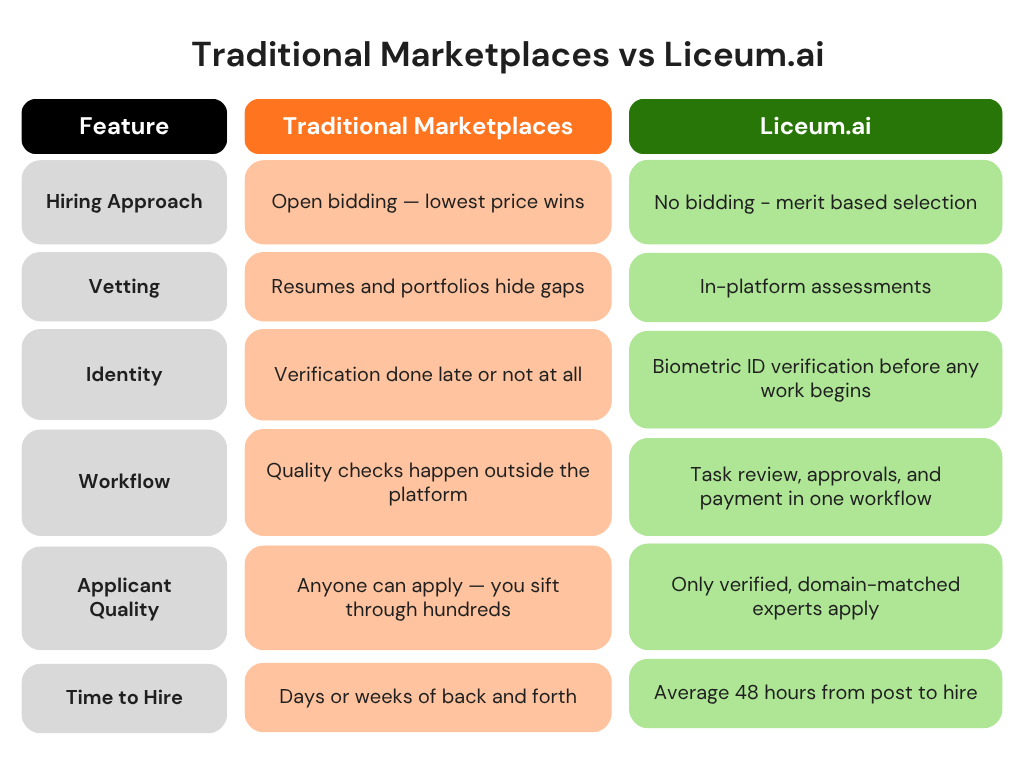
Key Differences Between Traditional Marketplaces and Liceum.ai
Liceum.ai was built around a simple idea. Hiring AI talent needs a more reliable way to identify and evaluate it. Since 2019, three key factors have shaped the platform:
- Verified AI talent: Every expert brings real domain experience, sourced from leading universities, research institutions, and hands-on industry experience, rather than open applications.
- Task-based assessment: Candidates are evaluated on real project tasks using your own criteria, so hiring is based on demonstrated ability, not just profiles or credentials.
- Built for the full AI lifecycle: From data annotation and LLM evaluation to prompt engineering and MLOps, Liceum.ai supports the range of expertise needed to build and improve AI systems.
Next, let’s take a closer look at each of these factors and how they define the way Liceum.ai works.
Sourcing AI Talent Who Actually Understand AI Work
Liceum.ai sources specialists from leading universities and research institutions, including the IITs and their global peers. Beyond academia, it brings in published researchers and experienced practitioners from fields like healthcare, law, and geospatial science, people who have spent years building the domain expertise that AI systems now depend on.
The best part is that Liceum.ai makes it easy to hire them with confidence. Every expert completes biometric ID verification before they can access a single project, with government-issued IDs authenticated so teams always know exactly who they’re working with. From there, hiring follows a clear path, from posting a project to running a real skills assessment to secure payment on completion.
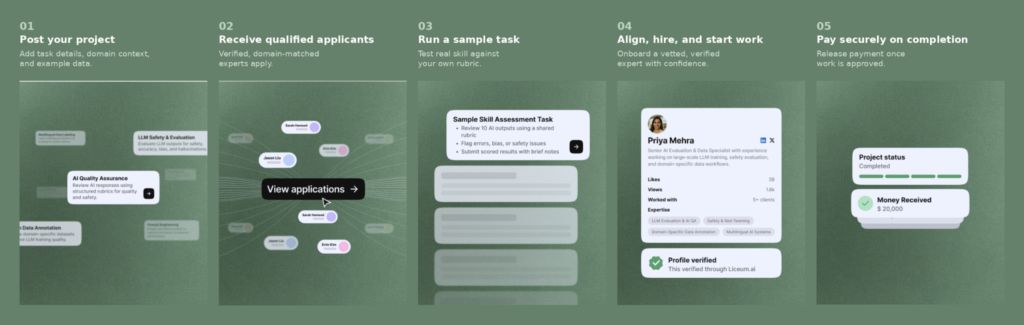
How Hiring Works on Liceum.ai, From Posting a Project to Secure Payment
How AI Talent Assessment Works on Liceum.ai Before You Hire
Knowing who someone is and knowing what they can do are two different things. Liceum.ai closes that gap by building assessment directly into the platform, so teams evaluate real ability before anyone is hired.
For instance, say a team is annotating radiology scans to train a diagnostic model. Through Liceum.ai, they can send shortlisted candidates a small set of real images and see who correctly flags a subtle nodule, applies the labeling protocol consistently, and knows when to escalate an ambiguous case.
A polished resume can’t show any of that, but a sample task does in an afternoon. The team grades the results against their own rubric, all in one place, with no email threads, external tools, or manual comparison to piece together.
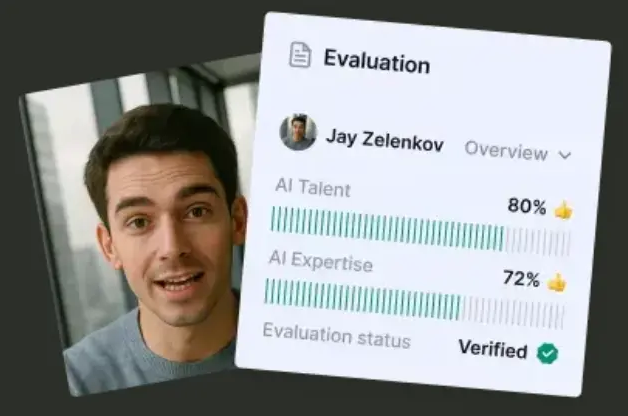
Liceum.ai Lets You Evaluate Candidates On Real Tasks Before Hiring
That is what we believe AI talent assessment should look like. It starts with seeing how people actually perform, then hiring on proof rather than claims.
Built to Support AI Talent Across the Full Lifecycle
Beyond verified experts and in-platform assessment, Liceum.ai is built to support the full arc of AI work. Every AI system that performs well has a workforce behind it that most people never see.
AI models don’t improve on their own. They’re trained, evaluated, corrected, and refined by AI specialists whose careful work rarely gets the spotlight, even as it shapes how AI solutions perform. Liceum.ai was built for exactly that workforce.
Since AI work spans from data annotation to model maintenance, the platform covers the full AI lifecycle, including data curation and LLM evaluation, content moderation, RLHF, prompt engineering, MLOps, and full-stack AI development. Across those workflows, Liceum.ai supports experts in more than 22 domains such as computer vision, autonomous systems, medical imaging, legal AI, finance, and audio and speech.

Every Successful AI System Depends On Experts Behind The Scenes (Source: Pexels)
The workflow is also streamlined. Every project on Liceum.ai moves through defined review and approval stages, with scope and milestones agreed before work begins. Deliverables are reviewed before payment is released, and anything ambiguous can be escalated for independent review, so quality holds up at every stage, not just at handoff.
Building a Community for AI Talent
Most talent platforms are built around transactions. A project is posted, a specialist is hired, the work is completed, and both sides move on. The relationship often ends as soon as the deliverable is submitted.
However, we designed Liceum.ai around a different idea. We wanted to create a place where specialists are recognized for their skills and continue contributing to work that matches their skills.

Liceum.ai Helps Build Long-Term Expert Relationships (Source: Pexels)
When a specialist delivers strong work, teams can bring them back for future projects. Over time, hiring becomes less about filling roles and more about building a trusted network of experts.
What We Believe About Great AI Work
Most platforms optimize for growth. We built Liceum.ai around a few convictions about what good AI work actually takes.
Great AI starts with the right people, not the most people. Flooding a project with applicants has never produced better outcomes. The right expert in the right place does. Yet when price becomes the deciding factor, expertise gets overlooked, and the best candidate loses to the lowest bid. That trade-off is exactly what we set out to remove.
Trust can’t be an afterthought either. Verification and accountability have to be built in from the start, because that’s what lets teams and specialists work together with confidence rather than hoping the other side is who they claim to be.
And good AI work moves faster with clearer standards, not fewer. When the scope is defined, the right expert is matched to it, and quality is built into the process, projects spend less time untangling problems and more time making progress.
What Six Years Has Taught Us About AI Talent
When we started in 2019, large language models weren’t a household topic, and generative AI still lived mostly in research circles. Compare that to now, and the two eras barely look like the same field.
But the core challenge never moved. Six years of building have taught us one thing above all. AI advances fast, yet quality still comes down to human judgment. Every new model, benchmark, and application rests on people who understand the domain behind the data. The technology keeps changing. The need for specialists who can train, evaluate, and refine it doesn’t.
That belief shaped more than our roadmap. We also came to believe the people doing this work deserved better than anonymous gig work and races to the lowest price. Expertise deserves respect, transparency, and fair recognition, and we built Liceum.ai around that core value as much as around the technical problem.
Where Liceum.ai and the AI Talent Gap Go Next
The AI talent gap that started all of this hasn’t closed. If anything, it’s widened, as AI has spread from research labs into healthcare, manufacturing, finance, and nearly every other industry. Far more organizations now need specialized AI talent, and finding and verifying it is as hard as ever.
So that’s where we’re focused. We’re growing the network, expanding into new domains, and making it easier for teams to find people who genuinely fit the work. We’re also investing in the experts themselves, building a place where they can grow their reputations and form lasting professional relationships, not just complete one-off gigs.
The future of AI won’t be decided by just models. It will be decided by the people behind them, and by whether the teams that need AI talent can actually find it. That’s the problem we’re here to solve.
Building an AI team ?
Hire verified AI talent on Liceum.ai and get matched with domain experts, no bidding, no guesswork.
Are you the expert?
Find real AI work at Liceum.ai and get paid fairly for your skills.





